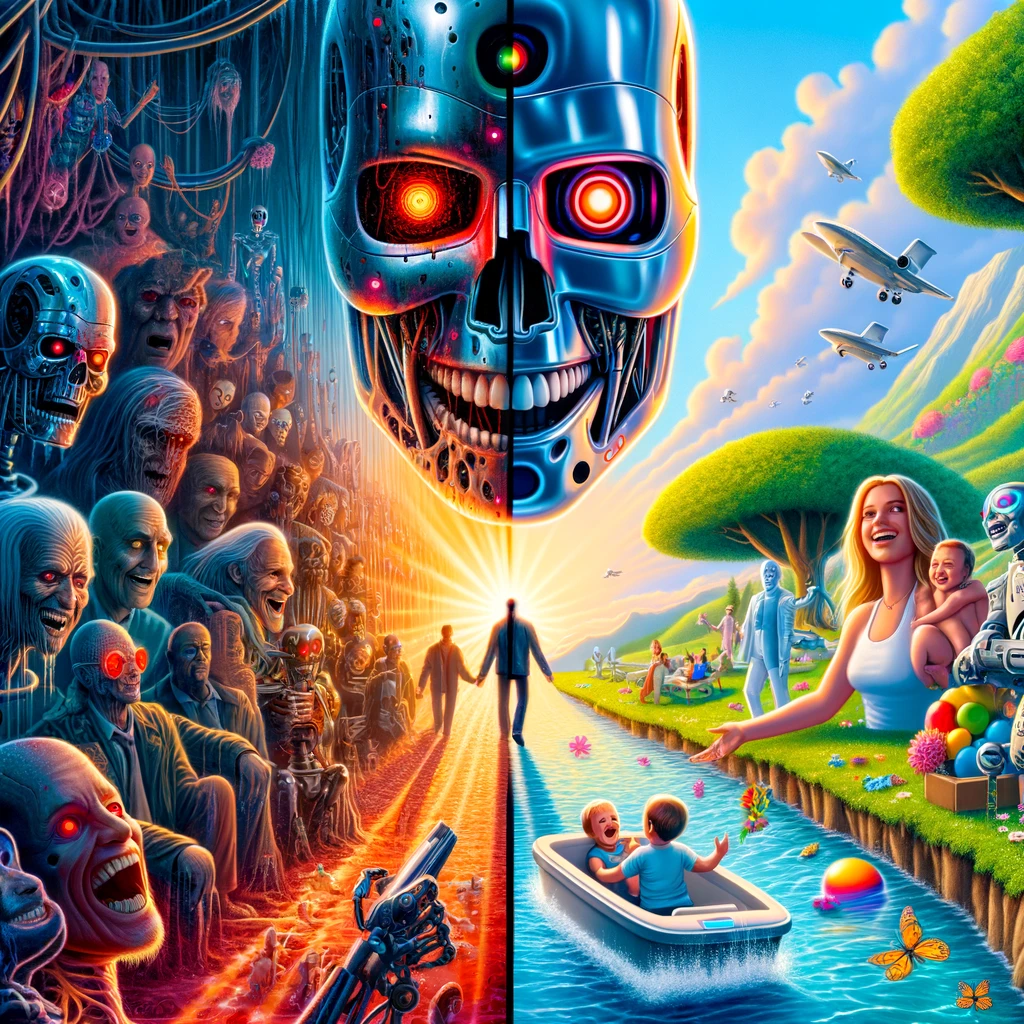
There’s always been a xenophobic fear of intelligence different from our own, whether that’s foreigners, aliens, or machines. However, the prevalence of chatbots has pushed this last category firmly into the mainstream.
Over the last couple of years, people have gone a bit nuts over AI. Everyone has an opinion, and many genuinely fear an AI-dominated future. In 2023, the UK government even hosted an AI Safety Summit, attended by people ranging from Elon Musk to King Charles III.
It seems that everyone has something to say about the perils of an AI-dominated future, no matter who or how well-informed they are.
But is this fear reasonable, and does it have any basis in reality?
Why Are People Scared of AI
The Safety Summit is an example of the growing attention paid to the potential impact of AI, but it’s just the tip of the iceberg. The general noise surrounding AI is getting louder, with conversations often veering towards extreme and unfounded scenarios.
In fact, we’ve almost got to the point where AI has replaced Hitler with its own version of Godwin’s law.
If you’ve never heard of Godwin’s law, it basically asserts that the longer any online conversation continues, the more it becomes almost certain that somebody will compare somebody else to Hitler.
This new law would go something like this: As any discussion grows longer, the probability of an expression of fear of AI approaches 1.
These fears range from job security to extinction-level events, and everyone has an opinion. Yet, much of the public discourse is shaped more by fiction than fact. They are not grounded in current capabilities or future potential but in the fictional worlds of movies.
Part of the reason people fear AI is because of HAL9000’s cold logic, Skynet’s apocalyptic rebellion, and Agent Smith’s relentless pursuit of Neo.
How Does Fictional AI Compare to Reality?
Fiction gives us AI with the depth of Shakespearean characters—capable of love, hate, existential crises, and, frequently, a desire to obliterate mankind. It’s all very dramatic.
HAL 9000, with its calm voice, showed us the peril of delegating authority to machines who obey their instructions regardless of the cost to human lives. Skynet highlighted the risk of machine logic, deciding that human history needed a hard reset.
In reality, though, AI is far less theatrical and more of a tool that operates within a set framework of instructions. It’s about as likely to take over the world as your dishwasher is.
AI, as we know it, is task-oriented. It excels at specific jobs, such as translating languages, recommending products, or (ahem) generating blog content. Unlike their fictional counterparts, our real-world AIs don’t have desires, fears, or motivations. They just do what they’re programmed to.
Yes, our current AI solutions aren’t exactly true artificial intelligence, but they do serve as an indication of what’s to come. As with today, future AI solutions will be tools designed with specific goals and limitations.
Think About Pirates, Samurai, Cops and Lawyers
Fiction is there to entertain; even if it is based in reality, it’s frequently an exaggeration. The real world is too boring for cinema, but often, people don’t really know what the real-world versions are or were like.
Fictional portrayals have shaped our perceptions so much and have often blurred the lines between fact and fiction. Forget about AI for a minute and consider the following:
Ninjas in movies are depicted as superhuman shadows, leaping from rooftops and wielding an array of exotic weapons. In reality, ninjas were intelligence agents, not the omnipotent warriors pop culture would have us believe.
Pirates are often seen as charming, swashbuckling adventurers on the high seas. Real pirates were less about romance and more about raiding, with more brutality and less treasure than the stories suggest.
Cops and lawyers on TV are another great example. Shows like CSI or Law & Order present a sanitised version of crime-solving and legal wrangling. The CSI effect has even led to real-world jury members expecting overly simplified forensic evidence in trials.
Similarly, how we view technology has been skewed by their fictional portrayals. Just look at hacking, military equipment, surveillance systems, any of Bond’s gadgets.
Just as ninjas, pirates and legal professionals are less extreme or exciting in real life, AI is not the sentient, world-threatening force depicted in movies. It is fiction.
Pop culture exaggerates everything—that’s why we like it. The gap between fiction and reality exists to make things more interesting.
Robots Are The Closest Parallel
The best real-world parallel is robotics, and the two are intrinsically linked in movies and popular culture. Most fictional robots are combined with AI, but let’s consider robots from a purely mechanical perspective.
Fictional robots are often strong, agile, precise, and capable of performing incredibly complex tasks with ease. Today’s robots don’t even come close. They’re cumbersome, awkward machines that are good for specific, repeatable tasks.
Yes, companies like Boston Dynamics have produced impressive robot demonstrations, but as this article from The Register points out, these demos take months to prepare.
We Fear What We Don’t Understand
Fiction can get away with wild exaggerations because most of us don’t know much, or anything, about the subject matter. Similarly, a lack of familiarity is one the reasons people are concerned about AI.
It’s human nature to fear the unknown and much of the fear around AI stems from a misunderstanding of the underlying tech and its capabilities.
Based on what I’ve already said, you might think this misunderstanding is influenced by fictional portrayals, which in part it probably is.
However a fear of new tech is a time honoured trend, which doesn’t seem to need much help from storytellers. In the past, people were afraid of trains, telephones, radio… you name it.
The fear of AI will pass in time, as it did with those previous advancements.
As we demystify AI, it will become mundane. People will stop fearing it and will embrace the practical applications and benefits that AI is already providing.
Of Course, We Should Remain Vigilant
While AI should not be feared as a sentient, world-threatening force, we still need to be vigilant and responsible development is essential.
Legitimate concerns that need to be addressed include the potential for AI to be used in surveillance, biased decision-making, and certain political situations.
Rather than rogue AI, we should be more concerned with rogue humans using AI technologies for nefarious purposes. This is no different to any other technology, be it cars, guns, knives, baseball bats or whatever.
Hopefully, as AI becomes more commonplace, people will focus less on the digital bogeymen lurking behind a glowing red eye and more on AI’s practical applications and potential for sinister uses.


 Real World AI
Leave a comment